


Dear onStrategy Reader,
You can now start a one-month free trial for "Where is my moat?"
You won't get my portfolio structure during the trial period, but you'll get enough information and insights that can convince you if it's worth it or not.
👉 Give it a try:
On to the update:
Why ChatGPT enters Health
OpenAI’s move into health is more about distribution. The company isn’t trying to become a hospital or even a health app, but it’s trying to become the interface through which people interact with complex systems. In this case, that system is the mess of medical records, wearables (Apple Watch), and symptom checkers that currently require ten taps, three portals, and a phone call. GPTs are increasingly commoditized, but in the process are becoming the default interface for a high-friction vertical with high value per user. If you can own “the thing people ask health questions to”, that’s a sticky entry point.
OpenAI is moving horizontally into every major vertical where information overload meets user confusion. Finance, health, education, legal. Health just happens to be the biggest and most trust-sensitive. While incumbents like Epic or Apple Health have better structured data, they lack the conversational layer that makes AI feel intuitive and omnipresent. OpenAI is betting that the UX wrapper is the moat. That’s why it wants access to health data: not to treat you, but to talk to you, and if you ask it enough questions before calling your doctor, it wins. OpenAI
📧 Finally: Gemini in GMAIL
Google adding AI overviews and summaries to Gmail is the most predictable outcome in AI, and also the correct one. When incumbents treat a new paradigm as a feature, it’s usually framed as defensive or unimaginative, but here it’s structurally advantaged. Gmail already owns the data, the context, the permissions, and the workflow. An external model trying to “help with email” is fighting uphill against access friction, latency, and user trust. Embedding AI directly into Gmail turns intelligence into infrastructure, and the implications are 3 fold: invisible, default, and hard to displace. The point is that Gmail stays the place where work happens.
This is fundamentally a distribution story. If models converge toward parity, then value accrues to whoever controls the surfaces where users already spend time. Google doesn’t need to invent a new AI product, but it just needs to make its existing ones quietly better. That’s the asymmetry OpenAI faces: it has the best conversational interface, but the incumbents have the interfaces that already matter. Google, Meta, Apple, Microsoft, and Amazon don’t need users to switch behavior, but they just slide AI into flows that already exist. In a world of commoditized models, distribution is the moat. LINK
🛒 Amazon plans “Big-Box” retail Store
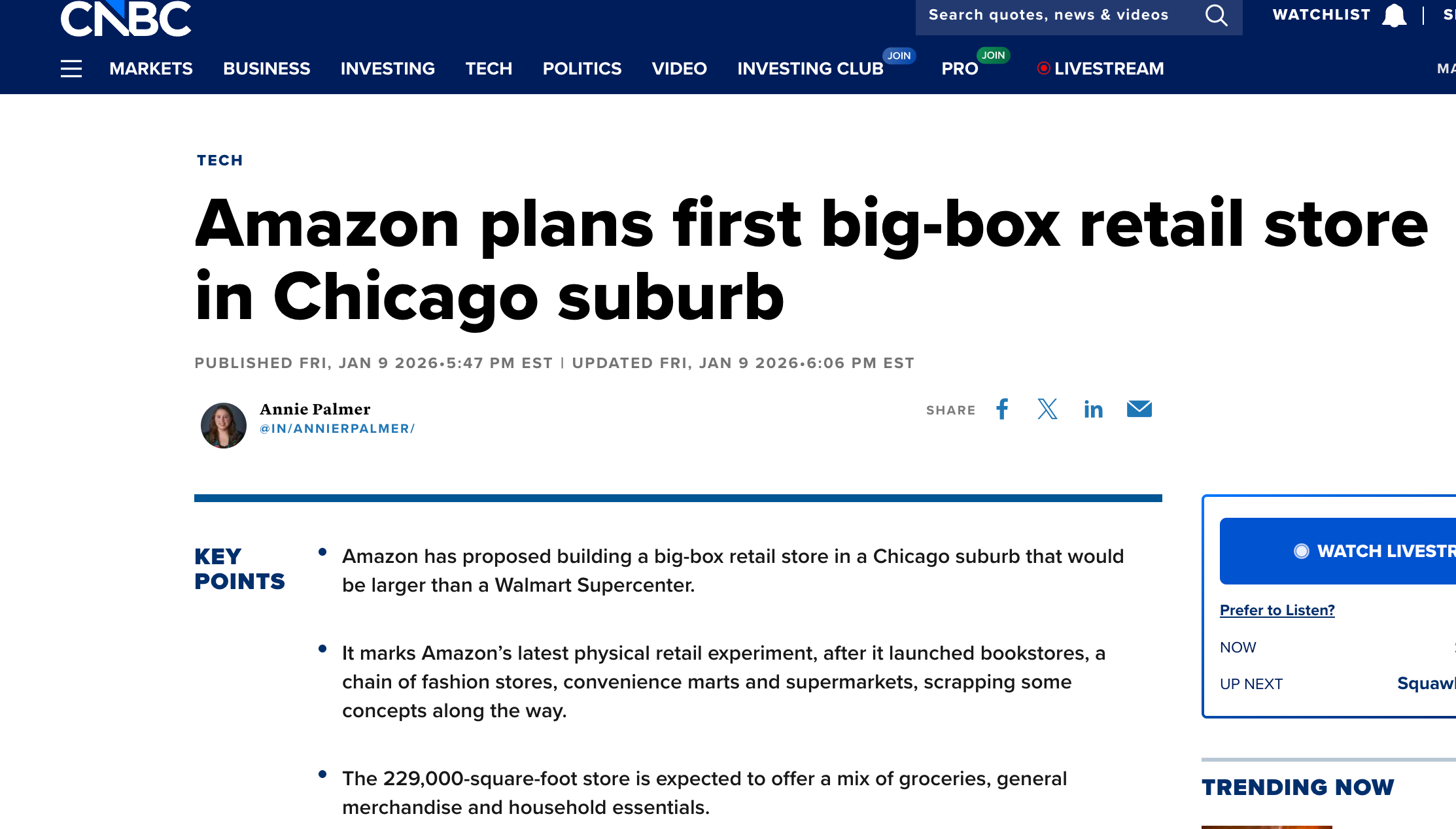
Amazon is apparently trying physical retail again, because of course it is. You see, when you’re already a $1.8 trillion e-commerce behemoth with your own planes, robots, web servers, and a sitcom’s worth of abandoned grocery store concepts, why not spin the roulette wheel one more time and try to reinvent Walmart? The logic is charmingly Bezosian: physical stores might be low-margin and logistically messy, but if there’s even a 1% chance of discovering the magical omni-channel hybrid that makes everything click (ie. the fulfillment center that also sells socks and hot dogs) then the optionality alone is worth the burn rate. Besides, if you’re Amazon, failure is a line item, not a red flag. CNBC
🚘 “Full Self-Driving” - as a subscription
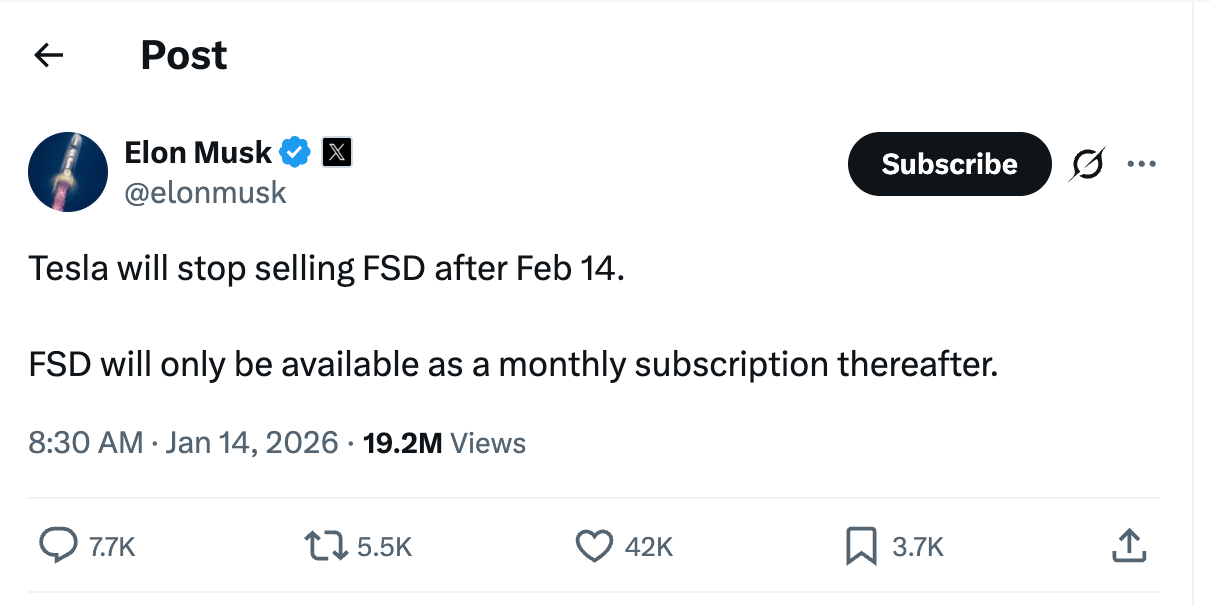
Here we are: Tesla’s Full Self-Driving (FSD) will no longer be available for purchase starting February 14, and will instead be subscription-only (probably $99 per month, or $999 per year). Which is perfect, because love is temporary but recurring revenue is forever. From a financial perspective, this is Elon’s classic “turn the knob” play: take a lump-sum software add-on and flip it into an annuity stream that fattens gross margins and provides Tesla with SaaS-style optionality. It’s less like selling you a car and more like putting you on a payment plan for your robot chauffeur. It is also convenient because it allows Tesla to preserve the illusion that FSD is still in beta while monetizing it like it’s already perfect.
More interesting, though, is the signaling game. Tesla’s basically telling you that self-driving is no longer a novelty or a gamble, but anutility, like Netflix or iCloud storage. The technology has improved to the point where locking in a permanent license feels like a mispricing. And since they control the OTA (over-the-air) pipeline, Tesla gets to flip the monetization model at will, which also makes resale math fuzzier. Can you sell a used car with a feature that now lives behind a paywall? Turns out, autonomy doesn’t just disrupt driving, but it also upends asset ownership. Welcome to the world where your car becomes a platform, and every feature gets monetized like an app.
WIMM - Where is my MOAT?
If you enjoy my strategy notes on LinkedIn or in OnStrategy, WhereIsMyMoat.com is the deeper, “skin-in-the-game” version: full theses, moat scoring, and a clear view of the company’s future performance.
Last week’s analysis:
🏡 Airbnb’s real moat is demand
🏎️ Ferrari’s scarcity stack
💰 The logic of my main stock portfolio (+62.5% in 2025)
This week’s analysis:
15th of January - My 2nd portfolio analysis (RO + PL)
16th of January - What stocks I might buy in 2026
17th of January - ASML
18th of January - TMSC