


Dear onStrategy Reader,
If you enjoy my strategy notes on LinkedIn or in OnStrategy, WhereIsMyMoat.com is the deeper, “skin-in-the-game” version: full theses, moat scoring, and a clear view of the company’s future performance.
Last week’s analysis:
[Essay] 🛍️ The Next Shopping Platform is an Interface
📈 The Two-Broker Strategy (what investing apps are out there)
This week’s analysis:
29 January - analysis for opening a 3rd portfolio
30 January - The end of software?
31 January - Walmart
1st of February - Costco
Onto the update:
🚀 Celestial listings and Capital markets: Elon’s Planetary IPO Play
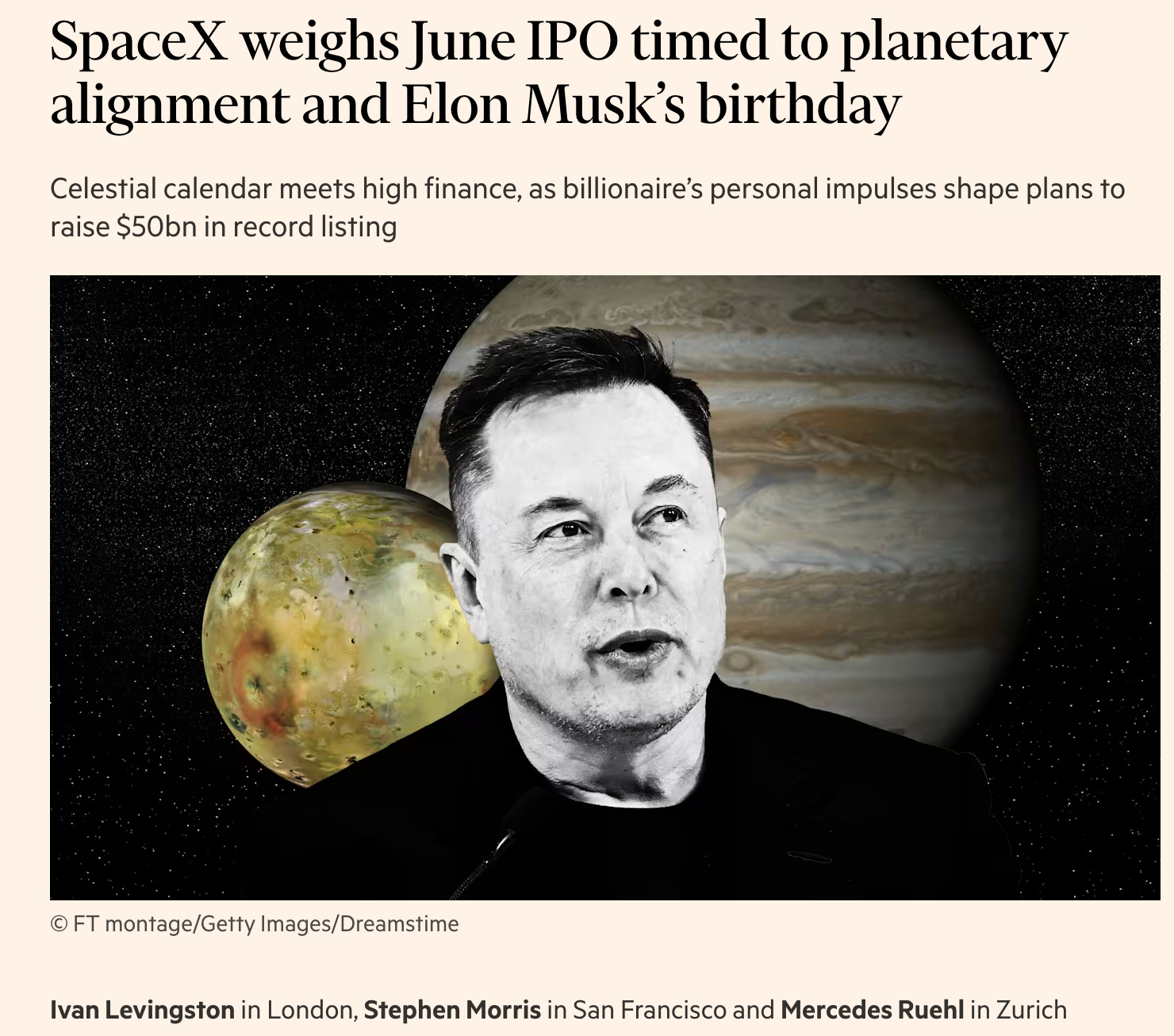
Elon Musk wants to IPO SpaceX in mid-June not because the financials are peaking or the macro environment is favorable, but because Jupiter and Venus will align… and it’s his birthday. Which, you know, is sort of adorable and also the most Elon thing imaginable. If you’re the kind of person who thinks markets are driven by discounted cash flows, this might make you twitch a little. But if you believe, as many investors secretly do, that vibes and narratives move markets more than spreadsheets, then aligning a $50 billion IPO with celestial movements and a billionaire’s birth might actually be smart. After all, if astrology moves crypto prices, why not rockets?
But behind the horoscope headline is a very terrestrial reason. SpaceX needs cash… a lot of it. With Starship development, AI compute ambitions, and Musk’s vision of building orbital data centers (which, let’s be honest, is the closest thing to real-life Halo infrastructure we’ve seen), the company is chewing through capital faster than it can privately raise at Musk-approved valuations. The $800 billion valuation floated in private markets last month is already a flex, but now they want $1.5 trillion. The demand from institutions and retail alike is going to be absolutely feral, especially after being locked out for so long. Musk may be eccentric, but he understands scarcity.
And that’s the core of the joke here. The listing is a spectacle designed by the man who sent a Tesla Roadster into orbit and tweeted “funding secured” at $420. But it might work, because Musk has built companies that operate outside traditional gravity, both physical and financial. If you believe the future runs on rockets, bandwidth, and AGI, then SpaceX is no longer just a space company, but a vertical integration of the 21st century. The planets may be aligning in June, but so are the incentives. Happy birthday, Elon. Here’s your $50 billion present. You are trillionaire now! FT
🇮🇹 Italy’s €2 Routing Fee
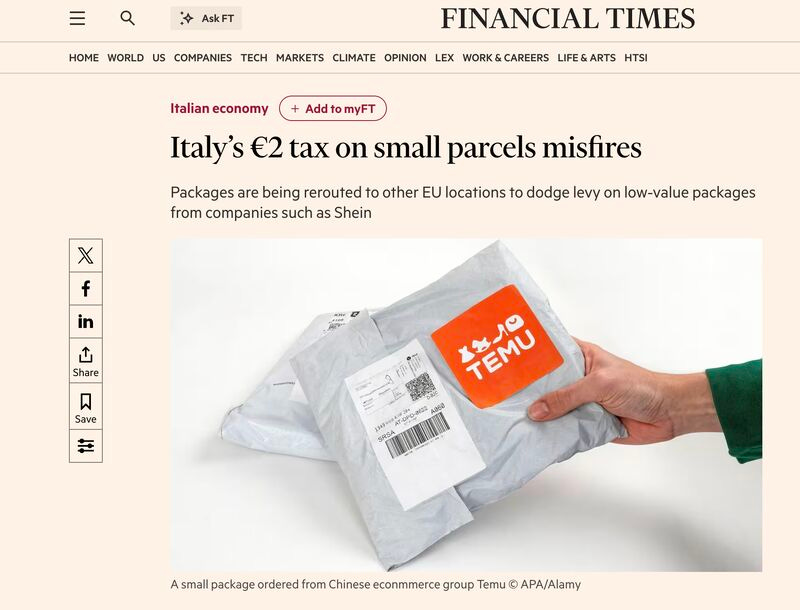
🇮🇹 Italy basically invented a new kind of tax, the “please land your plane somewhere else” fee.
The government slaps a €2 charge on sub-€150 parcels (hello, Shein/Temu), forecasts a nice, tidy €122m this year, and then watches as the parcels do what parcels do in a single market: they route around the obstacle with flights divert to Liège/Amsterdam/Budapest, Italy’s direct low-value arrivals drop 36% in the first 20 days, and the logistics guys are like ...
"congrats, you taxed our throughput while the goods still enter by truck, with extra pollution as a bonus".
This is a classic policy whack-a-mole. The EU’s whole thing is that once you clear customs you can circulate freely, so a national “handling fee” just turns into a geography game, and the funniest part is collection doesn’t even properly start until March....meaning Italy has managed to lose volume before it really collects the money, which is an extremely Italian outcome in the most affectionate sense. FT
🌽 Claude Code and the orchestration of corn
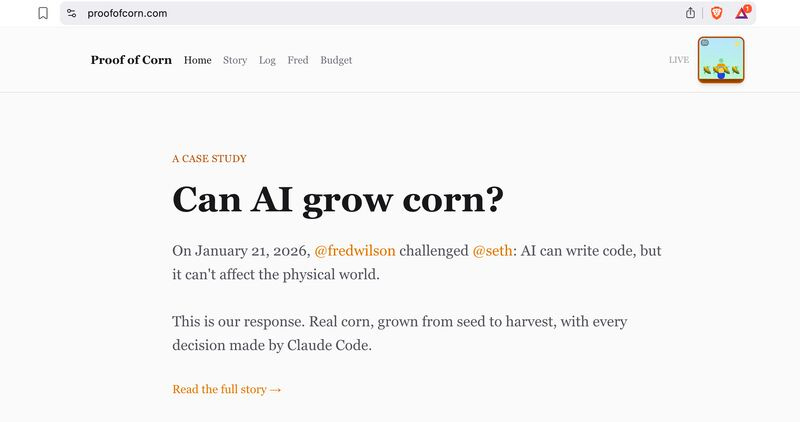
Seth Goldstein had dinner with Fred Wilson, and somewhere between the spring rolls and the walk back to the hotel, Fred said: “You can’t grow corn with AI”
... and like any rational person who took that as a personal attack, Seth launched a website, an ops stack, a decision engine, and an actual farm.
Powered by Claude Code, Anthropic’s AI that’s being treated more like a COO than a chatbot, this thing is now managing land leases, irrigation decisions, and coordinating with seed suppliers. I suppose that means we’ve reached the “software eats agriculture” phase of the cycle. Fred said you can’t make dinner, but it turns out if you’re the one hiring the chef, writing the grocery list, and running the kitchen… you’re sort of the chef now?
It’s AI orchestrating humans and services as if it were the farm manager. AI doesn’t need to do the physical labor... it just needs to know how to make decisions and send instructions to the people or tools that do.
That’s a different kind of automation, more Uber than Boston Dynamics. “Proof of Corn” might sound like a meme, but it’s a serious blueprint for how AI becomes an interface layer to the real world. The fact that it all started because someone said “you can’t” makes it even more inevitable.
The next harvest? Probably coming from an LLM prompt. LINK
Two AI Economies
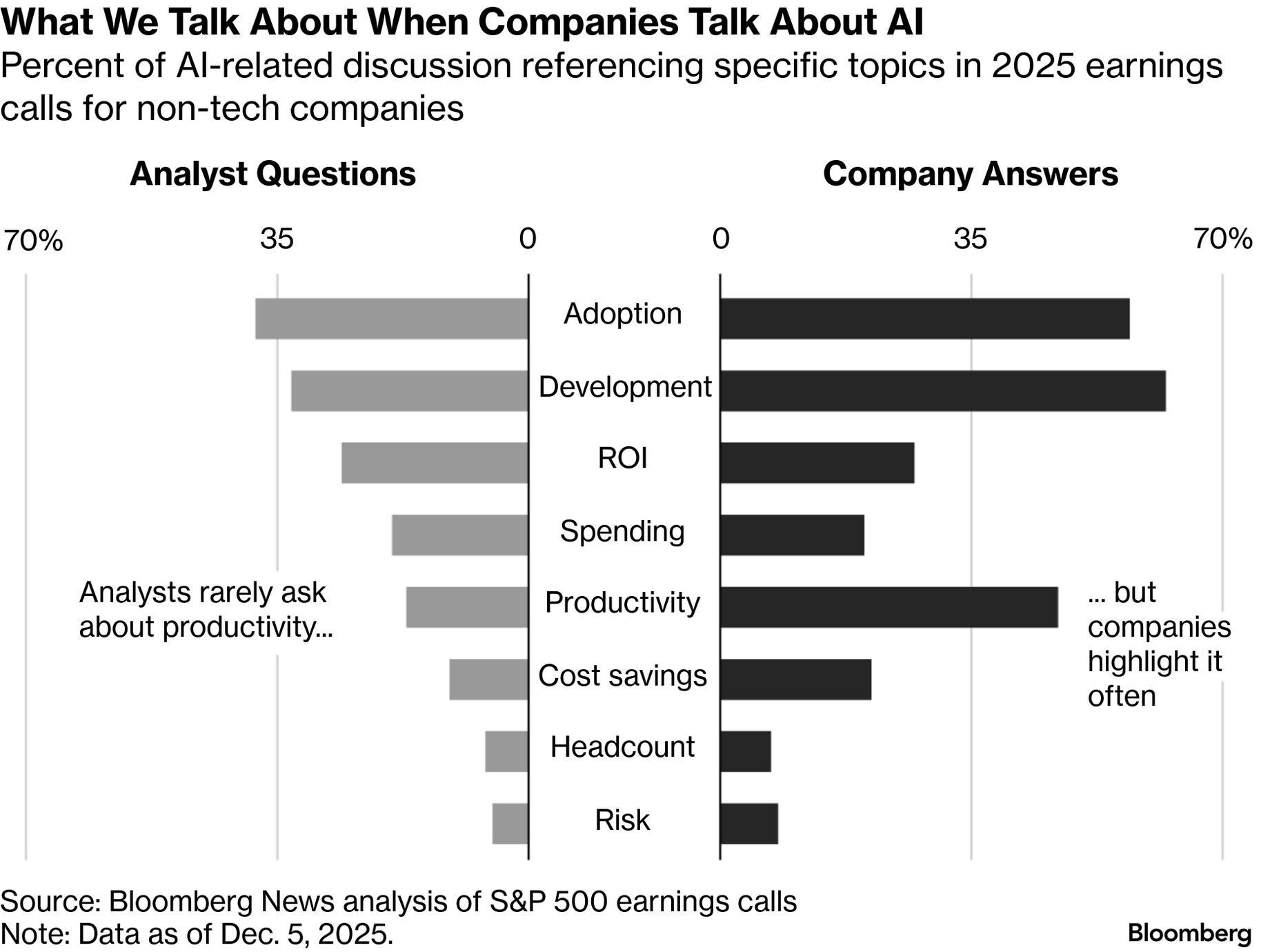
Wall Street is having the most Wall Street conversation imaginable about AI. With tech companies, it’s all “show me the monetization path” and “how are you financing the capex to build Skynet", while with everyone else it’s basically "so…uh…have you considered putting ChatGPT in a hotel lobby?"..
..even though US businesses (outside the “AI builders”) spent an estimated $86B on AI in 2025 and are expected to spend $131B next year, which feels like the sort of thing you might ask about if your job is "ask questions" (but fewer than half of S&P 500 companies got any generative-AI questions in 2025, versus >80% of tech in the most recent quarter).
It looks like management teams keep talking about productivity, cost savings, headcount, etc., and analysts keep asking about adoption/development/ROI like they’re shopping for use cases on Etsy; and that’s how you get dot-com-bubble vibes.
A lot of investment upstream, a lot of confidence in destiny, and not enough curiosity about whether the rest of the economy is actually absorbing the thing fast enough to justify the buildout.
on crime (🇷🇴 vs. 🇸🇪 vs. 🇬🇧)
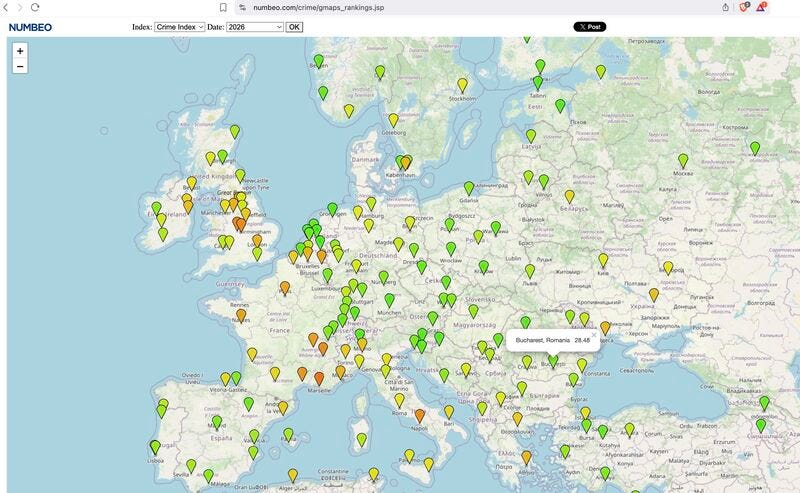
According to Numbeo’s Crime Index, Bucharest is basically a Swiss spa town (28.5) while Gothenburg is a war zone (45.83) and London is Mad Max with Pret (55.7). Malmö (🇸🇪) is the “bombing city” of Europe at 55.03, which is a very expected outcome if you import immigrants who develop parallel societies.
Big international cities are crime-content factories. London has more tourists, more pickpockets, more headlines, more viral videos, more “this city is finished” discourse. Sweden has a whole export industry of “Nordic dystopia” stories. Meanwhile, Bucharest’s biggest comparative advantage here might be "come here! It's super safe and we don't have bad neighborhoods" (to be fair, as of 2023, the Swedish Police Authority identified 59 geographical areas, often referred to in media as "no-go zones")
You can absolutely use these numbers to win an argument on the internet. But if you’re trying to decide where to live, invest, or walk home at night, you probably want to live in those places for 1-3 months to see if it's for you or not.
Numbeo tells you what people say they feel. Reality can be harsher. LINK
🍽️ AI eats software
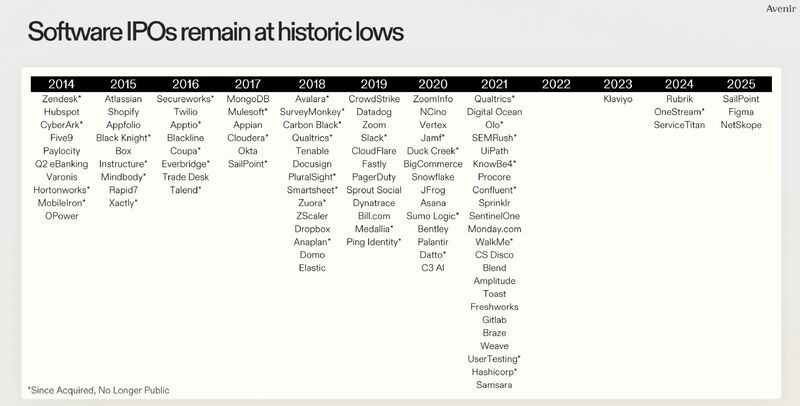
Yesterday, I did a deep dive into the software industry ("AI eats software")
The 2014-2021 era was "IPO as graduation". The 2022-2025 era is “IPO in AI times”.
Software didn’t stop being important; it's just that investors just decided they’d rather own it through megacaps, private rounds, or M&A… than through a newly public company explaining quarter-by-quarter. LINK
Thank you for being an onStrategy reader!
Interesting newsletters 💡
Great issue! TIL about proof of corn - very interesting, thank you!