


Dear OnStrategy Reader,
here is what you will find in this issue:
🧐 The 30-person company scaling to 500 Million users
The Algorithm of Love
🚗 Ford meets its BYD moment
📈 God, Growth, and ETFs
🇩🇪 Germany’s “China Shock” revisited
📺 YouTube Is TV Now
Electric cars are easy —> 🏎️ Ferrari is hard
…and more:
Onto the update:
🧐 The 30-person company scaling to 500 Million users

In a world where scale is usually equated with headcount, the most striking thing about Nikita Bier’s latest posts is not the number, 30 employees, but the contrast: Meta has 87,000, Microsoft 221,000, Google 190,000… and X’s core product team fits into a group text. The implication is not that big companies are broken, but that leverage has shifted. Platforms that once required thousands to operate at scale can now be rebuilt by a handful of senior engineers, a designer, and a founder who still reads his DMs.
This story is more about velocity and control, not cost-cutting. With zero middle management, no product committees, and instant feedback loops, ideas move from code to production faster than a weekly sprint review. The company is flat, not lean. You don’t climb a ladder, you ship. And when you ship, you don’t present a deck, you touch half a billion users.
AI, infra-as-a-service, and modular stacks have turned “team size” from a constraint into an optionality lever. The trade-off is no longer scale vs. speed, but legacy bloat vs. atomic focus.
Welcome to the endgame: single-digit teams with infinite surface area.
The Algorithm of Love
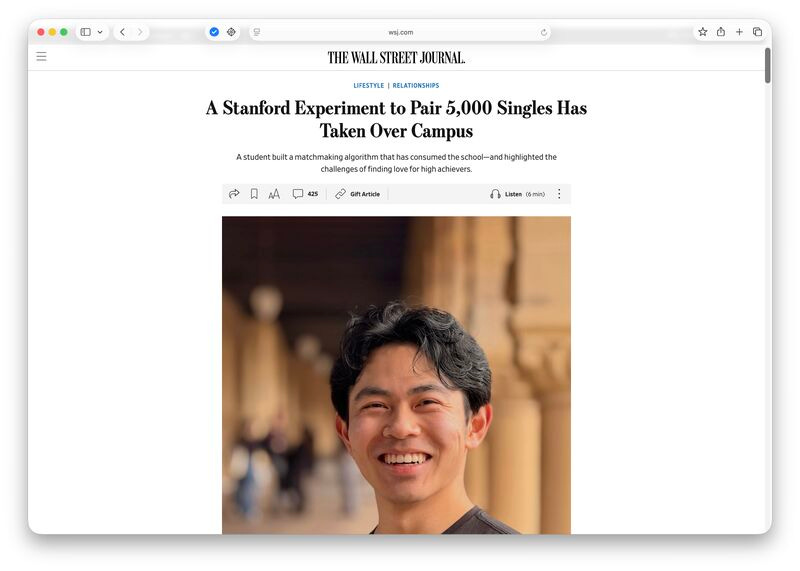
Apparently, the hottest startup at Stanford is not an AI agent or a crypto protocol.... it’s Date Drop, a matchmaking app that delivers one suggested partner every Tuesday night at 9 PM. Over 5,000 students are on it.
The appeal for using it? It reduces the cognitive load of dating in a campus full of Type-A optimizer brains. It’s engineered serendipity for people who schedule spontaneity between compilers and case interviews.
Date Drop doesn’t promise magic, but it simplifies the friction of connection. In a world where tech automates your shopping, your commute, and your schedule, why not outsource romance too? If nothing else, you might match with someone who funds your Series A. At Stanford, that counts as chemistry. WSJ
🚗 Ford meets its BYD moment
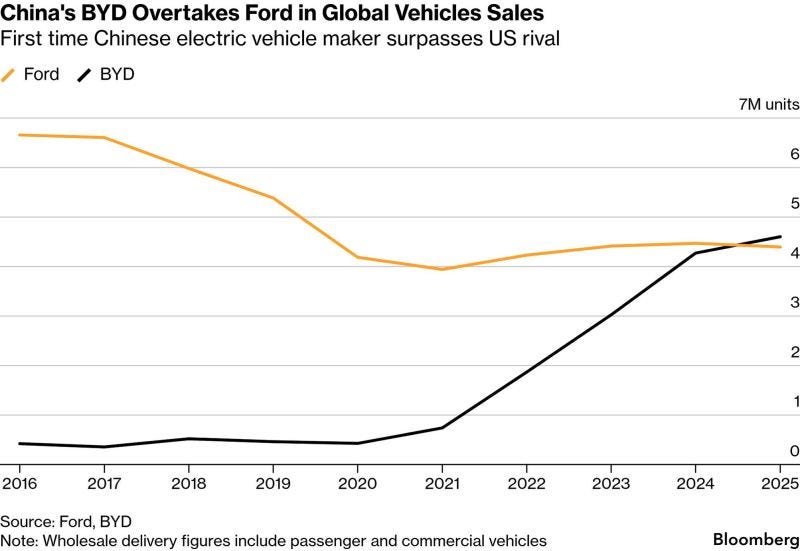
It turns out Ford has finally met its match. China’s BYD just outsold Ford globally for the first time ever, moving 4.6 million vehicles in 2025 versus Ford’s 4.4 million. That 200,000-unit difference may sound modest until you realize it was driven by BYD’s 7.7% growth and Ford’s 2% decline. It’s like Ford was running on a treadmill while BYD took the elevator.
This story is more about direction. Ford’s been busy writing off $19.5 billion in EV-transition charges (!), while BYD quietly turned into a global juggernaut, expanding across Europe, Latin America, and Southeast Asia with price-competitive (= super subsidized), tech-heavy EVs.
Meanwhile, Ford’s US sales held up, but it bled market share in China, where BYD, Geely, and even Xiaomi now play the home court advantage in the EV game. The good news for Ford is that Toyota still keeps everyone humble at the top with 11.3 million cars sold, so at least there’s a big boss to point at. The bad news is that this isn’t just a blip. BYD’s exports hit 1.05 million units and it wants 1.3 million in 2026. It’s like Ford is showing up to a software-defined EV future with a factory recall notice in hand, while BYD shows up with a discount, a WeChat integration, and a charging station in every zip code. Ford might still be Ford, but in this global race, it’s now looking more like General Electric than General Motors. Bloomberg
📈 God, Growth, and ETFs
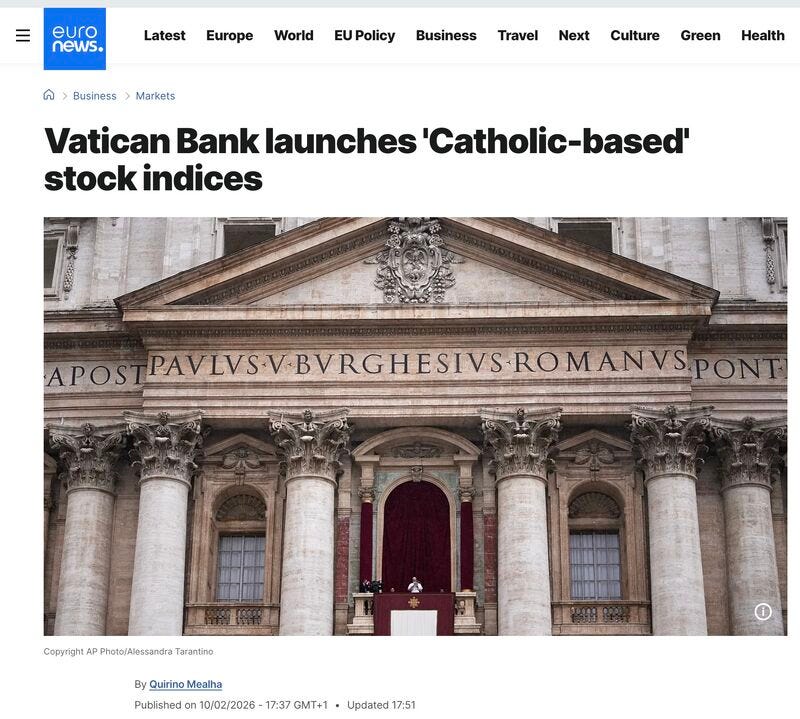
Of course the Vatican is launching stock indexes. After 2,000 years of moral guidance and indulgence arbitrage, it makes perfect sense to apply Catholic principles to portfolio construction.
The indexes reportedly include companies like Meta and Amazon, which suggests the moral filter is a bit more Aquinas-meets-BlackRock than pure Benedictine austerity. Still, there’s something oddly poetic about your investment portfolio getting blessed while still holding Big Tech. After all, if the Lord moves in mysterious ways, so does capital allocation.
Once you’re in the indexing business, you’re not just blessing people, you’re blessing capital. Allocating grace through passive flows. Which is maybe the most efficient form of salvation yet.
🇩🇪 Germany’s "China Shock" revisited
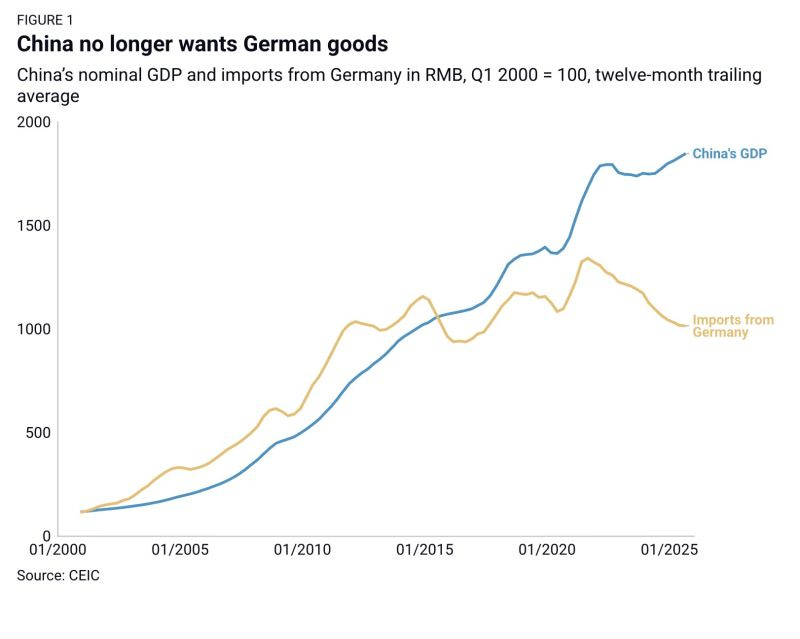
The German economic model was built like a luxury car (ie. engineered to precision, humming along on exports, and for the better part of two decades, heavily dependent on the China autobahn). The idea was simple. Germany makes the high-end machines, China buys them, and everyone gets richer. But it turns out that if you drive a BMW into a high-speed industrial rivalry, eventually someone else builds the road... and the car. What the Rhodium report shows, in painstaking detail and sad German charts, is that China no longer wants to be the demand side of Germany’s export machine. Imports are down, market share is collapsing, and the auto surplus with China is falling off a cliff that starts somewhere around the year 2022. Industrial competition is the present and Germany’s machine is stalling.
The bigger irony, of course, is that Germany’s famously rules-based, ordoliberal approach leaves it philosophically unarmed in a moment when everyone else, from Beijing to Washington, is embracing active industrial policy. The EU has started to flirt with protectionism, but Berlin remains stuck between its legacy love affair with China and its allergy to "picking winners". Meanwhile, China is aggressively picking markets, undercutting prices, cornering supply chains, and occasionally weaponizing rare earths just to make a point.
Germany keeps talking about de-risking while watching its factories lose margin, market share, and eventually jobs. The old model (ie. export to China, stay efficient, don’t intervene) is not malfunctioning. It’s obsolete. If Merz returns from Beijing without a new playbook, Berlin may discover that economic autopilot only works when you’re still flying. Rhodium Group
Electric cars are easy —> 🏎️ Ferrari is hard
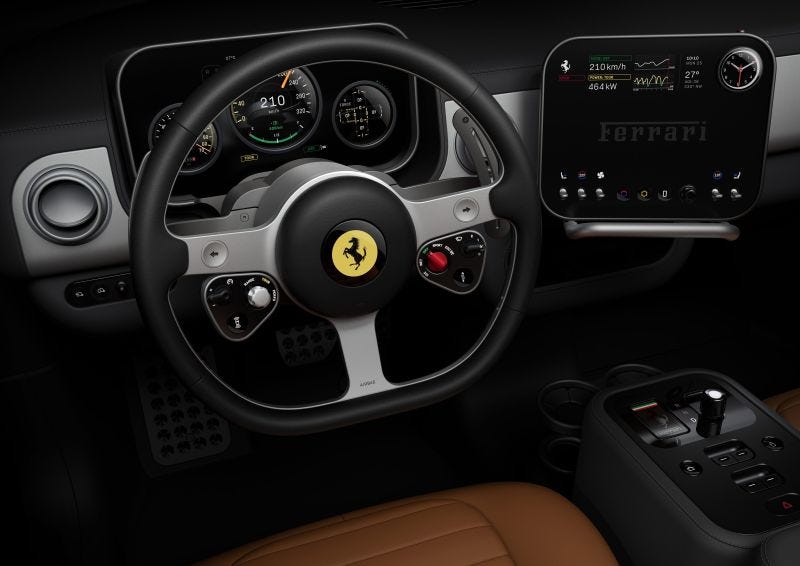
One thing about Ferrari making its first electric car is that they hired Jony Ive's design studio to help them figure out how to put a steering wheel and some buttons in it. This is a little bit like if you were opening a restaurant and hired a famous chef to consult on the menu, except the chef's most famous accomplishment was removing all the ingredients from food. LoveFrom, Ive's post-Apple design collective, is best known for making computers and phones that have approximately zero buttons and tactile switches, so naturally Ferrari brought them in to design "tactile switches and custom interface" that "connect the driver with the car in a completely new way".
The new way, apparently, is with physical controls, which you might think is actually the old way, but calling it new is how you justify the consulting fees. Also the press release mentions "authentic Ferrari experience" three times in two sentences, which is what you say when you're worried people will notice your electric car is silent and doesn't smell like gasoline.
The broader point here is that luxury carmakers have discovered that their EV problem is actually a branding problem disguised as an engineering problem. Anyone can make an electric car go fast in a straight line (ie. that's just batteries and motors, commodity parts you can buy from suppliers). The hard part is making people feel like they're driving a Ferrari when the engine doesn't scream and the exhaust doesn't pop.
Tesla proved you can sell electric cars by making them feel like computers. Ferrari is trying to prove you can sell electric Ferraris by making them feel like Ferraris, which seems obvious until you realize the thing that makes a Ferrari feel like a Ferrari is mostly the part they're removing (!)
📺 YouTube Is TV Now
YouTube wants to unbundle your TV before you unsubscribe
Here’s the plan! Take the legacy cable bundle, slice it up like a sushi roll, and reassemble it inside YouTube, only this time with slightly less guilt and slightly more Google. For $65 a month, a magical number that is somehow still considered a “discount”, you can now get all the sports your dopamine-deprived brain craves. YouTube’s actually doing the à la carte thing cable companies promised for decades but never delivered, mostly because they liked money and leverage and channel bundles that no one asked for. Now that half of those bundles have disintegrated into subscriber dust, Youtube gets to play the hero by offering a broken cable package that somehow feels fresh.
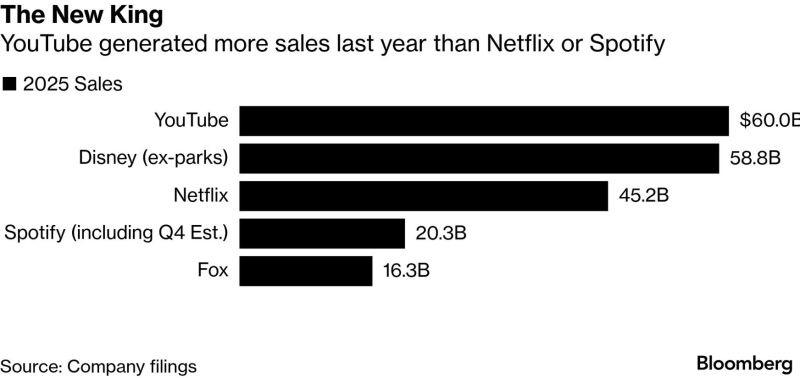
YouTube is making more revenue than Disney’s media business, and doing it while letting creators teach you physics, cook dinner, and argue about Taylor Swift’s playlist all in one feed. If Google wins TV the same way it won web search, it won’t be because it had better shows, but it’ll be because it had the pipes, the eyeballs, the ad tech, and a platform where everyone wants to hang out.
I have long advocated (in blog posts, in my book, etc) that Netflix's real competitor is Youtube, not HBO.
🧐 [Essay] AI - The End of the Beginning. A Case for Optimism
"Without AI, we would have been in an economic crisis/stagnation. [...]
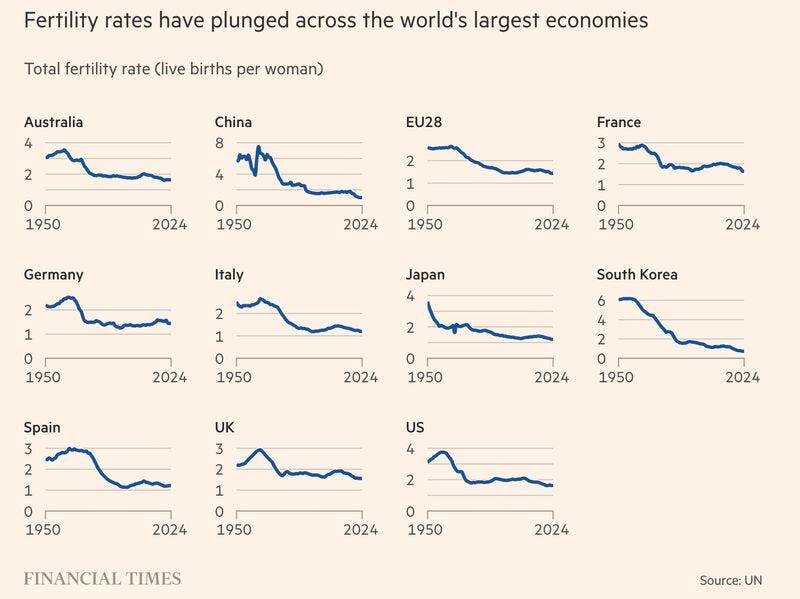
This is why I believe the timing of AI has worked out miraculously well. We are going to have AI and robots precisely when we need them to substitute for a shrinking population and to kickstart economic growth. In this future, I see human workers being at a premium, not a discount. The fear of "job loss" is, in my view, an overly simplistic model that ignores the reality of "task loss". Jobs are bundles of tasks. While AI will automate specific tasks, the jobs themselves persist and evolve. I look at the history of coding as a perfect example. We moved from machine code to assembly, then to high-level languages like C, and then to scripting languages like Python. Each layer abstracted away complexity, and rather than destroying the role of the programmer, it made them more productive and more numerous. AI is simply the next layer of abstraction, allowing one person to orchestrate an army of code-bots, making them 10 or even 100 times more effective than before. From this point of view, AI is augmenting humans, not replacing them." - read if all HERE.
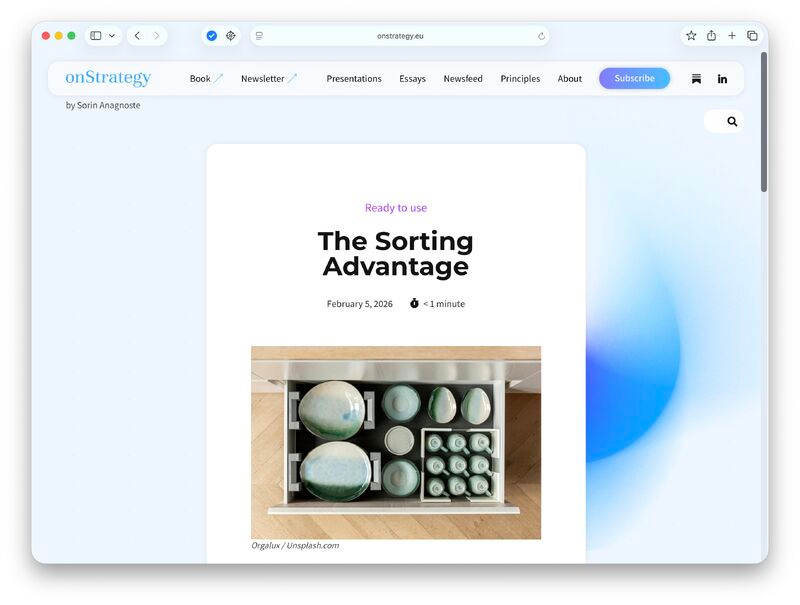
[PRINCIPLE] The Sorting Advantage
Most of what we call “work” is sorting.
Sorting signal from noise. The customers who fit from the ones who don’t. The “good enough” from the “worth it”.
The mistake is lazy sorting: choosing proxies because they’re easy to count, not because they’re true. Metrics that look scientific but measure the wrong thing. Rankings that reward conformity instead of competence.
Better sorting is leverage. It saves time, protects attention, and compounds quality.
Pick your sorting rules on purpose, before the world picks them for you.
“Where is my MOAT?” - updates
12 Feb - [Essay] AI - The End of the Beginning. A Case for Optimism.
13 Feb - How Tesla and Google are reinventing their moats in real time
14 Feb - [Deep dive] Oracle’s AI Backlog Problem
15 Feb - [Deep dive] ARM becomes Infrastructure
Here’s the schedule:
Feb 17 — a deep dive on Bitcoin
Feb 18 — updates on Amazon and Microsoft (what changed, what didn’t)
Feb 19 — a February 2026 macroeconomics deep dive — and yes, this is a new category I’m introducing to WIMM (because markets don’t move in a vacuum)
Feb 20 — Eli Lilly deep dive
Feb 21 — Pfizer deep dive
Subscribe one month for FREE: