


Dear OnStrategy Reader,
Here is what you will find in this issue:
New Apple MacBook? The $699 Trojan Horse
AI - The productivity trap?
Bitcoin was supposed to be “digital gold”…is NO
Flush with AI 😅
Short-form video is bulldozing Gen Z’s attention span (e.g. TikToks, Reels, Shorts)
Waymo - Driverless, except for the door 😅
on UberEats
[Essay] AI - The End of the Beginning. A Case for Optimism
…and more
Onto the update:
New Apple MacBook? The $699 Trojan Horse

Apple is preparing to launch a low-cost MacBook on the 4th of March.
Implications? With this launch, Apple is taking its most powerful moat, the ecosystem, and pushing it down the income stack. If the rumors are right, this is basically “iPad economics in a laptop shell”: an iPhone-class chip (likely A18 Pro), an aluminum chassis, a 12.9-inch display, and a price “well below $1,000” (likey $699). That combination matters because it changes the entry-level decision from “Which Windows laptop is least bad at $699?” to “Do I want the computer that already speaks my phone’s language?”. The win condition isnlifetime value: iCloud, Apple Music, App Store, accessories, and eventually an iPhone upgrade that feels “obvious” because your laptop is already in the family.
Will it disrupt the entry-level PC market? It depends on what Apple compromises. If Apple can deliver “good enough” keyboard, battery, and screen while keeping macOS (not a weird iOS-on-laptop experiment), then yes, it’s a serious attack on the big volume tier that Windows OEMs live on, because Apple’s cost structure is different. It controls the silicon roadmap and can amortize it across hundreds of millions of iPhones, then repurpose that efficiency into a cheaper Mac.
The second-order effect is pressure. OEMs have to compete on price while also paying for Windows and buying commodity parts, which is a tough way to make money. Apple, meanwhile, gets to “sell the starter Mac” and still make the real profit later, in services and upgrades. If you’re a PC maker, this is the scariest kind of competition, where the rival treats your margin pool as their customer acquisition cost. Macrumors, Ming-Chi Kuo (Apple analyst)
The productivity trap?
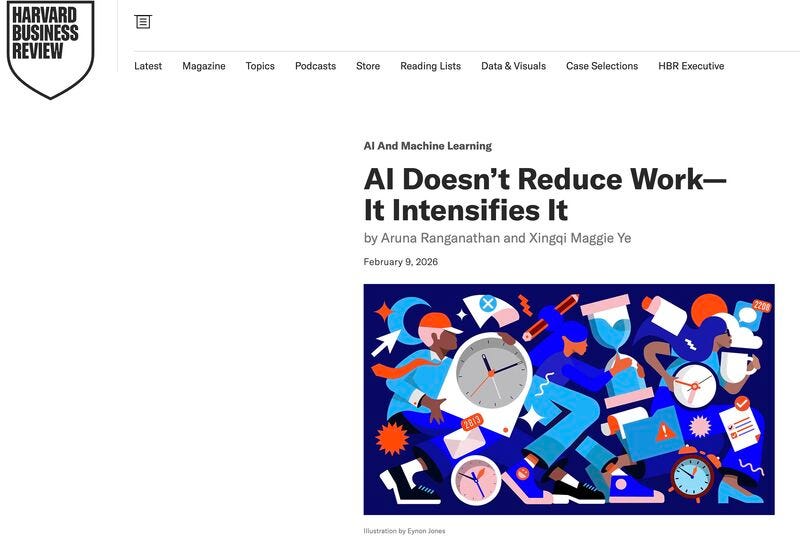
One of the great promises of AI was liberation (example: fewer rote tasks, more thinking, maybe even leaving the office on time). Instead, according to new research in Harvard Business Review, AI tends to function less like a labor-saving device and more like a cognitive energy drink.
In an 8-month field study at a 200-person tech company, employees who adopted generative AI tools did not shrink their workloads, but expanded them. They took on adjacent roles, blurred the line between "my job" and "their job", and filled small pockets of downtime with "just one more prompt". Engineers became reviewers of everyone else’s AI-assisted output. Product managers started coding. Work did not disappear, but it metastasized.
The bullish case for AI often assumes automation converts effort into leisure. The emerging reality suggests automation converts effort into ambition. When starting a task becomes frictionless, more tasks get started. When iteration becomes cheap, scope expands.
The result is a self-reinforcing loop of speed, expectation, and cognitive load with more output, higher standards and fewer pauses (!!). The authors argue for developing an intentional “AI practice” to prevent silent workload creep. That framing matters because the real risk is not that AI fails to boost productivity. It is that it succeeds so well that organizations quietly redefine what "normal effort" means.
In that world, AI does not replace work, but raises the baseline. HBR
Bitcoin was supposed to be “digital gold”…is NOT

Bitcoin was supposed to be “digital gold”, meaning when everyone panics about fiat, Bitcoin does the calm, reassuring thing and goes up.
Instead, it did the exciting, modern thing and went down 44%, while people quietly bought actual gold like it’s 1974 and they own a mustache.
The funny part is, we’re not early anymore. There are ETFs, institutions, tokenization panels, the whole Wall Street institutions, yet none of that seems to accrue to the tokens themselves.
More about Bitcoin in my latest blog update
Subscribe for free for one month. (Where is my MOAT?)
Flush with AI 😅
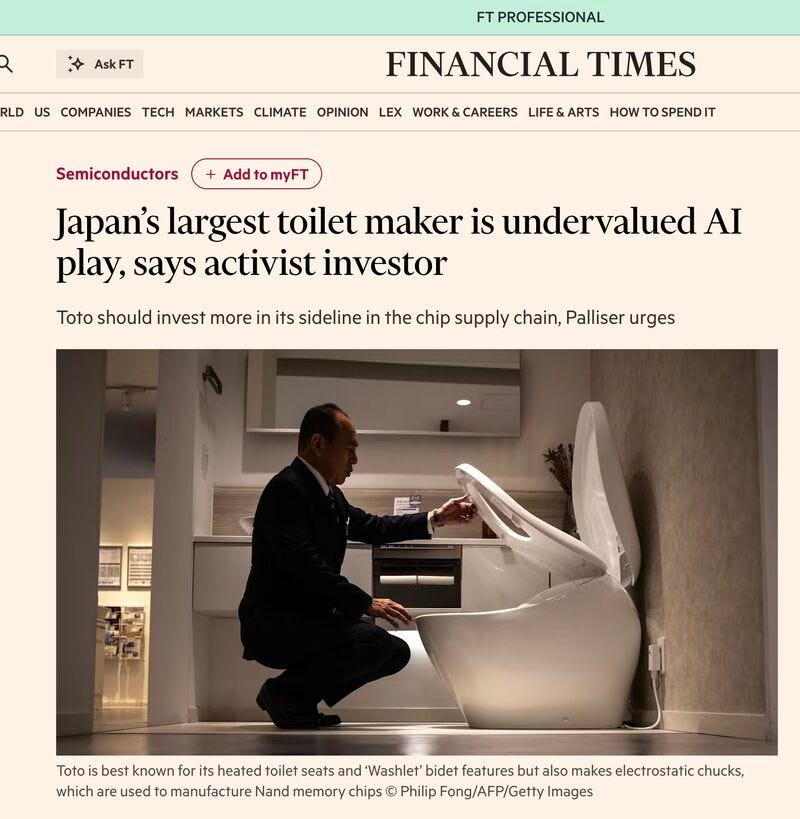
There are many ways to play the AI boom. You can buy GPUs. You can buy hyperscalers. Or you can buy a Japanese toilet company that secretly makes mission-critical ceramic components for NAND memory fabrication. According to the FT, Toto, best known for heated seats and Washlets, generates 40% of its operating profit from advanced ceramics used in semiconductor manufacturing, specifically electrostatic chucks that hold silicon wafers in place during production.
Memory prices are rising, AI workloads are driving NAND upgrades, and suddenly, the company that perfected the art of porcelain is a five-year moat AI beneficiary. Of course it is. The future runs on GPUs and also on extremely stable ceramics that can survive cryogenic etching.
This is classic AI industrial spillover. Ajinomoto turned umami chemistry into chip insulation. Toto turned toilet ceramics into wafer-handling precision hardware. The activist thesis is straightforward: reallocate capital, highlight the semiconductor exposure, cut cross-shareholdings, deploy JPY 76 billion of net cash, and let the market reprice the story as infrastructure... instead of bathrooms 🫠
Shares are already up more than 60% over the past year, and the pitch is that they can go another 55% higher (no investment advice).
In the AI cycle, the highest margins often sit in the least glamorous bottlenecks. Sometimes the real AI trade is not the model. It is the component that keeps the wafer perfectly still while the model gets built. FT
Short-form video is bulldozing Gen Z’s attention span (e.g. TikToks, Reels, Shorts)
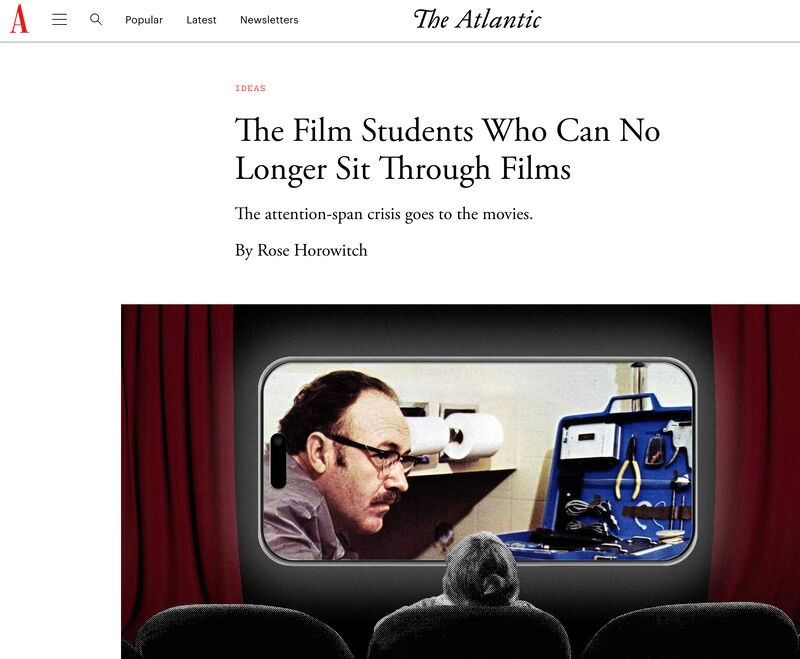
Rose Horowitch’s piece in The Atlantic describes film professors who cannot get film students to sit through feature-length movies, with many furtively checking phones even during climactic scenes. Which is funny, because for 20 years Hollywood executives have been obsessing over "engagement", and now they have achieved maximum engagement with the wrong screen. The kids love movies. They just prefer to watch 2 of them simultaneously, vertically, in thirty-second increments, while also texting. If you are a Coppola character delivering a moody, existential monologue, you are competing with a push notification. The notification wins.
Universities are long-duration attention vehicles trying to finance themselves with short-duration cognition. Film school used to assume the scarcest resource was access to movies; now the scarce resource is sustained focus.
The irony is that the streaming era solved distribution and accidentally destroyed immersion. When even USC film students treat The Conversation like a background tab, the business model of “just pay attention at the end” stops working. The real special effect in 2026 is not CGI. It is two uninterrupted hours of looking at one thing.
Good luck with that!
Driverless, except for the door 😅
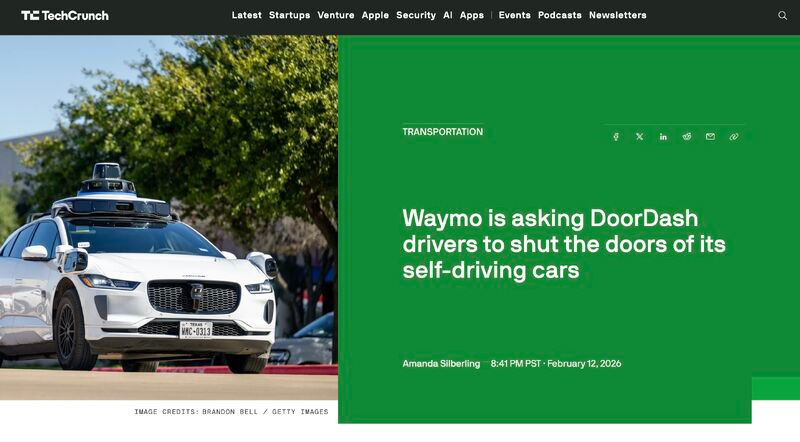
According to TechCrunch, Waymo is literally paying DoorDash drivers to go close the doors of its stranded cars for $6.25 plus a $5 bonus in Atlanta. Silicon Valley spent a decade eliminating the driver, and now it has reinvented the valet.
What looks like absurdity is really modularity. When the marginal cost of downtime exceeds the cost of summoning a human, you summon a human. That is platform thinking. Waymo automates 99.9% of the driving stack and then arbitrages the last 0.1% through DoorDash. It is a reminder that autonomy does not mean the absence of people. It means the strategic deployment of people at the highest-leverage moments. The robot drives. The gig worker closes the door. Venture capital funds both. Welcome to the hybrid economy, where the future is autonomous, except when it is cheaper not to be...🫠
on UberEats
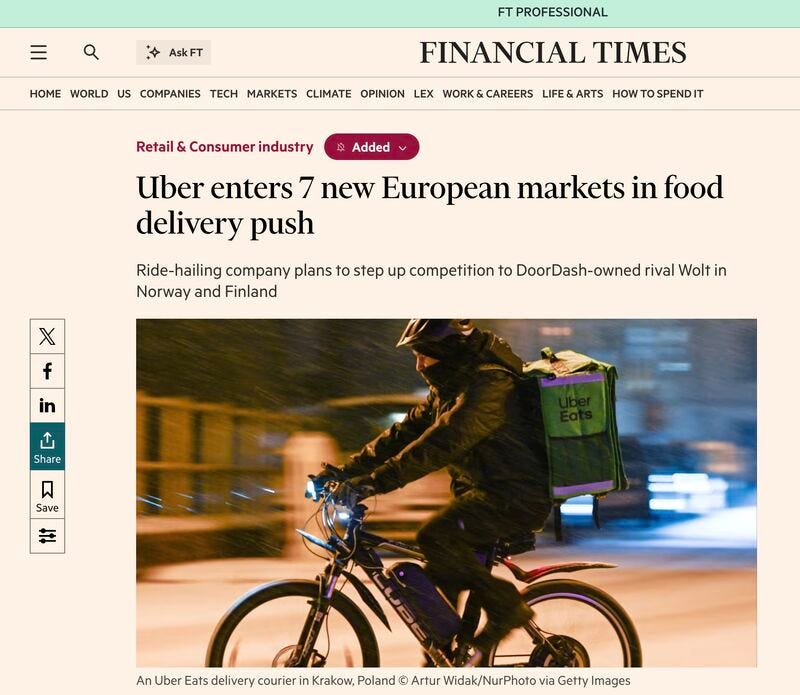
As the FT notes, the company is expanding into seven new European markets, including Romania, in a push that aims to add $1bn in gross bookings over three years. That number is about winning Europe through density. Food delivery is a scale game layered on top of another scale game. Uber already has rides, payments, maps, memberships and customer relationships. When it re-enters a market like Romania, it does not start from zero. It starts with an installed base, cross-selling from mobility to meals, and a cost structure that improves as volume compounds. The lesson from its earlier withdrawal is that food delivery without multi-product leverage is a grind. The lesson from its return is that food delivery with platform leverage becomes a margin expansion tool.
The article highlights M&A across Europe and Uber’s plans for drones and robots. In other words, the endgame is fewer players, more scale, and eventually lower variable labor costs. The real moat is not restaurants or couriers. It is distribution, data, and the ability to amortize technology across rides, groceries, food, and in-time, autonomous logistics. Uber left when the economics were local. It returns because the economics are now platform-level. FT
Opinion: The Marlboro Man and the power of manufactured myth

There was a time when a cigarette ad could feel like cinema. The Marlboro was felt like selling the frontier mythology at scale. A lone rider and endless horizon. It was brand as narrative dominance.
What made those ads magical was clarity. Freedom, masculinity, silence, danger, self-reliance. In one frame, you understood the promise.
Today, brands optimize for click-through rates and A/B tests. Back then they optimized for archetypes. The cowboy was the interface and the cigarette was the API.
Of course we know how the story ends. Regulation arrives. Health data accumulates. The myth collapses under reality. Yet there is something nostalgic about that era of advertising when brands aimed for transcendence (magic), instead of engagement.
For a while, in the golden light of a staged Western sunset, that confidence felt like magic.
[Essay] AI - The End of the Beginning. A Case for Optimism
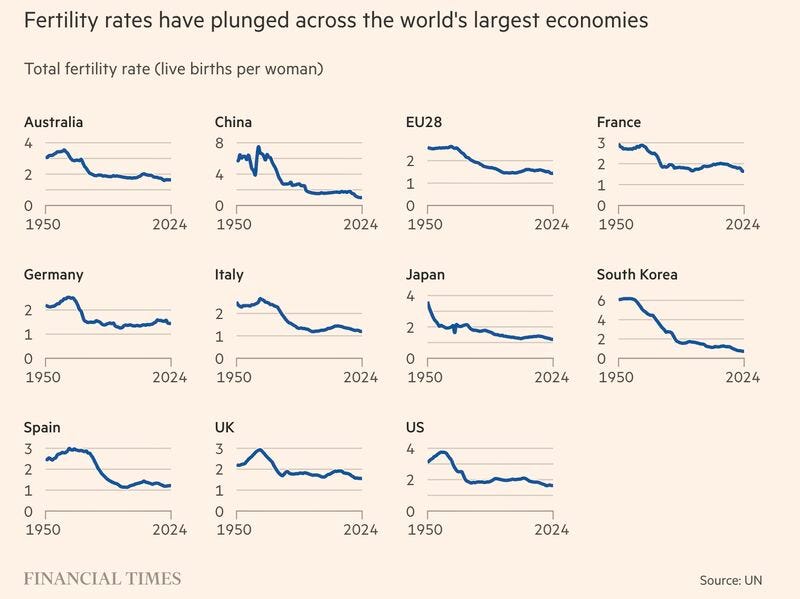
"Without AI, we would have been in an economic crisis/stagnation. [...]
This is why I believe the timing of AI has worked out miraculously well. We are going to have AI and robots precisely when we need them to substitute for a shrinking population and to kickstart economic growth. In this future, I see human workers being at a premium, not a discount. The fear of "job loss" is, in my view, an overly simplistic model that ignores the reality of "task loss". Jobs are bundles of tasks. While AI will automate specific tasks, the jobs themselves persist and evolve. I look at the history of coding as a perfect example. We moved from machine code to assembly, then to high-level languages like C, and then to scripting languages like Python. Each layer abstracted away complexity, and rather than destroying the role of the programmer, it made them more productive and more numerous. AI is simply the next layer of abstraction, allowing one person to orchestrate an army of code-bots, making them 10 or even 100 times more effective than before. From this point of view, AI is augmenting humans, not replacing them." (Read the full essay)
Personal promo 😎
Your problems were solved by others.
You can move faster.
Work with me:
I consider "Where is my MOAT?" to be like a mini-MBA 😎
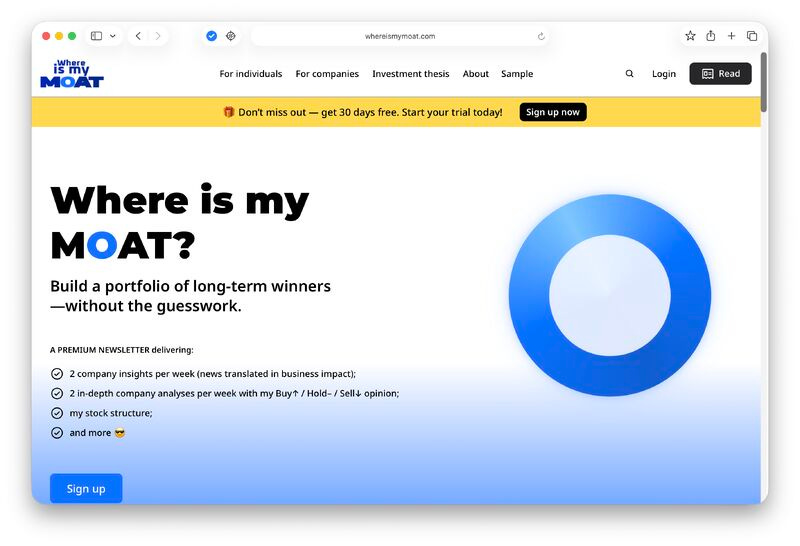
This week, my subscribers get five posts, five different lenses on the world.
Here’s the schedule:
Feb 18 — a deep dive on Bitcoin
Feb 19 — updates on Amazon and Microsoft (what changed, what didn’t)
Feb 20 — a February 2026 macroeconomics deep dive — and yes, this is a new category I’m introducing to WIMM (because markets don’t move in a vacuum)
Feb 21 — Eli Lilly deep dive
Feb 22 — Pfizer deep dive
…and here are the posts from last week:
12 Feb - [Essay] AI - The End of the Beginning. A Case for Optimism.
13 Feb - [Analysis] How Tesla and Google are reinventing their moats in real time
14 Feb - [Deep dive] Oracle’s AI Backlog Problem
15 Feb - [Deep dive] ARM becomes Infrastructure
If you find WIMM useful, please share it with a friend or a colleague. WIMM is free for one month ... plenty of time to decide if it’s worth keeping in your stack.